Both ends of this protein are the same colour
The rainbow running along these structures encodes residue number, which really is ordered. Print it in greyscale and the first residue and the last arrive at the same tone.
Structural biologists colour a protein chain from blue at one end to red at the
other. It is not a stylistic tic. It is a documented mode in the standard
tools: ChimeraX ships rainbow as a synonym for color sequential, which
gives a
different color for each residue in a biopolymer chain
. Everyone in the
field reads it without thinking, which is the definition of a convention
working.
The usual complaint about rainbow colourmaps does not apply here. A rainbow is normally wrong because it invents order in a variable that has none, and residue number has order: the first residue really does come before the last. A sequential ramp is the right family of answer. The problem is which one.
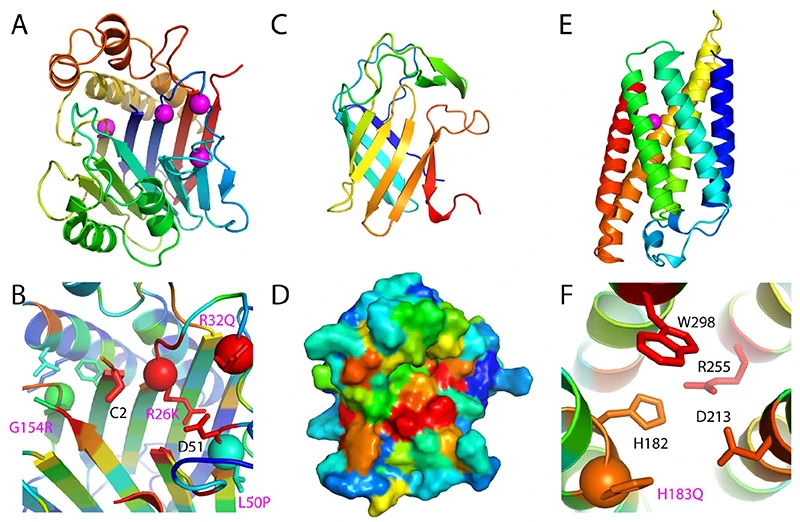
Figure 3 from the RoseTTAFold paper
Six panels of protein structure, each coloured along the chain from one terminus to the other. Reproduced under CC BY 4.0 from the author accepted manuscript deposited in Europe PMC. That is deliberately not the typeset version in Science, which carries the Science Journals Default License and could not be reproduced here: the CC BY applies to the accepted manuscript, through the rights retention the paper's Wellcome funding requires.
- The ramp runs blue, cyan, green, yellow, orange, red along the chain. Measured against matplotlib’s own definition of jet, this figure covers 52% of that locus contiguously, which is what separates a ramp from a set of categorical colours that happen to span the hue wheel.
- On a surface rendering the ramp reads as territory. The eye takes the cyan-to-green edge for a boundary between two regions, when it marks nothing except that the chain has kept going.
- The magenta and red spheres mark particular residues. They are a categorical mark laid over a continuous ramp that is already using the whole hue wheel, so the marker has no hue left that means only "look here".
A sequential ramp does its work through lightness. That is what survives a monochrome printer, a bad projector and every kind of colour blindness, and what lets a reader put two points in order without consulting a key.
This ramp’s lightness does not run in one direction. Across the sixteen steps
sampled in data/rosettafold it climbs and falls again, a
cumulative reversal of 101.7% of its own
range with a single drop of 38.5%.
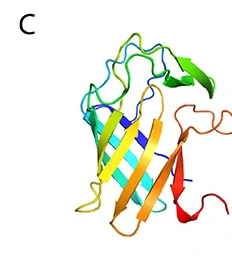
As published
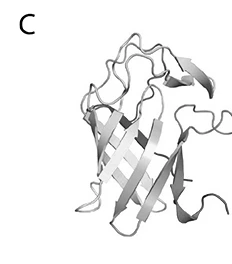
Desaturated
One panel, as printed in colour and in grey
Our derivative, not the authors' figure: panel C desaturated with the luminance weights this site's contrast check uses. The two ends of the chain differ by 0.008 in relative luminance. The middle of the chain differs from both by about twenty times that.
| Position on the chain | Colour | Relative luminance |
|---|---|---|
| First residue | #0000bf | 0.038 |
| Middle of the chain | #ffff00 | 0.928 |
| Last residue | #800000 | 0.046 |
Both ends of the chain arrive at the same tone. The middle, no more important than anywhere else, is the brightest thing in the picture. A ramp whose job is to say this comes before that has made the two ends indistinguishable and put the emphasis where nothing is happening.
None of which makes the structures wrong or the prediction less remarkable. It would have cost one argument to avoid: a perceptually uniform ramp carries the same ordering in lightness, so the chain still runs one way when the colour is gone. The convention is doing something real. It is just doing it with the one part of colour that does not survive being printed.